There are easier ways to reach Machu Picchu. Faster ones, too.
A train can take you there in just a few hours. A well planned itinerary can make the journey smooth and efficient. Yet, for many travelers, something feels missing when the destination comes too easily.
Inca Trail trekking offers something entirely different.
It slows time. It deepens the experience. It builds anticipation with every step. Somewhere along the path between the mountains, the silence, and the rhythm of walking the journey itself begins to matter as much as the destination.
That is what makes it unforgettable.
Walking Through a Living Landscape
At first, it’s the scenery that captures your attention.
The Andes do not reveal themselves all at once. They unfold gradually. One ridge leads to another, one valley opens into the next. The light shifts constantly, painting new textures across the mountains.
In some moments, the trail feels vast and open, with endless horizons and crisp, thin air. Then, almost suddenly, everything changes.
The path narrows. The vegetation thickens. The air becomes warmer, richer. You begin to hear water flowing somewhere below or birds echoing through the forest.
This transition from high-altitude terrain to cloud forest is not just visual. It’s deeply sensory.
You are not just observing a landscape. You are moving through layers of it.
A Path That Carries History Beneath Your Feet
One of the most powerful aspects of Inca Trail trekking is how present the past feels.
This is not a recreated route. It is the original Inca path, built stone by stone centuries ago. You can feel it beneath your feet the uneven steps, the natural curves, the way the trail follows the contours of the mountains.
There is a quiet intelligence in its design.
The path does not fight the terrain; it flows with it. It climbs where necessary, rests where possible, and adapts seamlessly to the landscape.
As you walk, it’s impossible not to imagine those who once traveled this route messengers, priests, and pilgrims each moving with purpose.
That sense of continuity is what makes the experience so powerful.
A Different Sense of Time
Modern travel is fast. Flights, schedules, and itineraries are designed for efficiency.
The Inca Trail works differently.
Here, time expands.
There are no distractions, no constant notifications. Your focus shifts to something simpler: the next step, the next view, the present moment.
And in that simplicity, something changes.
You begin to notice details the way morning light touches the mountains, the texture of ancient stones, the silence that surrounds you.
It’s not forced. It happens naturally.
And the further you go, the more meaningful it becomes.
Hidden Inca Sites Along the Way
Throughout the trail, ancient Inca sites appear almost unexpectedly.
They are not introduced with grand entrances or signs. Instead, they reveal themselves quietly around a bend, above a valley, or hidden among the mountains.
These sites feel integrated into the landscape.
Terraces blend into hillsides. Stone structures align perfectly with nature. Everything feels intentional, harmonious.
They are not just ruins to observe they are part of a larger story that connects the land, the trail, and the people who once lived here.
When the Journey Becomes the Destination
Many travelers see Machu Picchu as the ultimate highlight.
And it is.
But the Inca Trail changes that perspective.
The journey becomes just as meaningful as the arrival.
Each step, each landscape, each moment builds a deeper connection. By the time you arrive, you are not simply seeing Machu Picchu you are understanding it.
The First Glimpse of Machu Picchu
Near the end of the trail, something shifts.
The atmosphere becomes quieter. The path narrows. There is a subtle sense that something is about to reveal itself.
And then, gradually, it does.
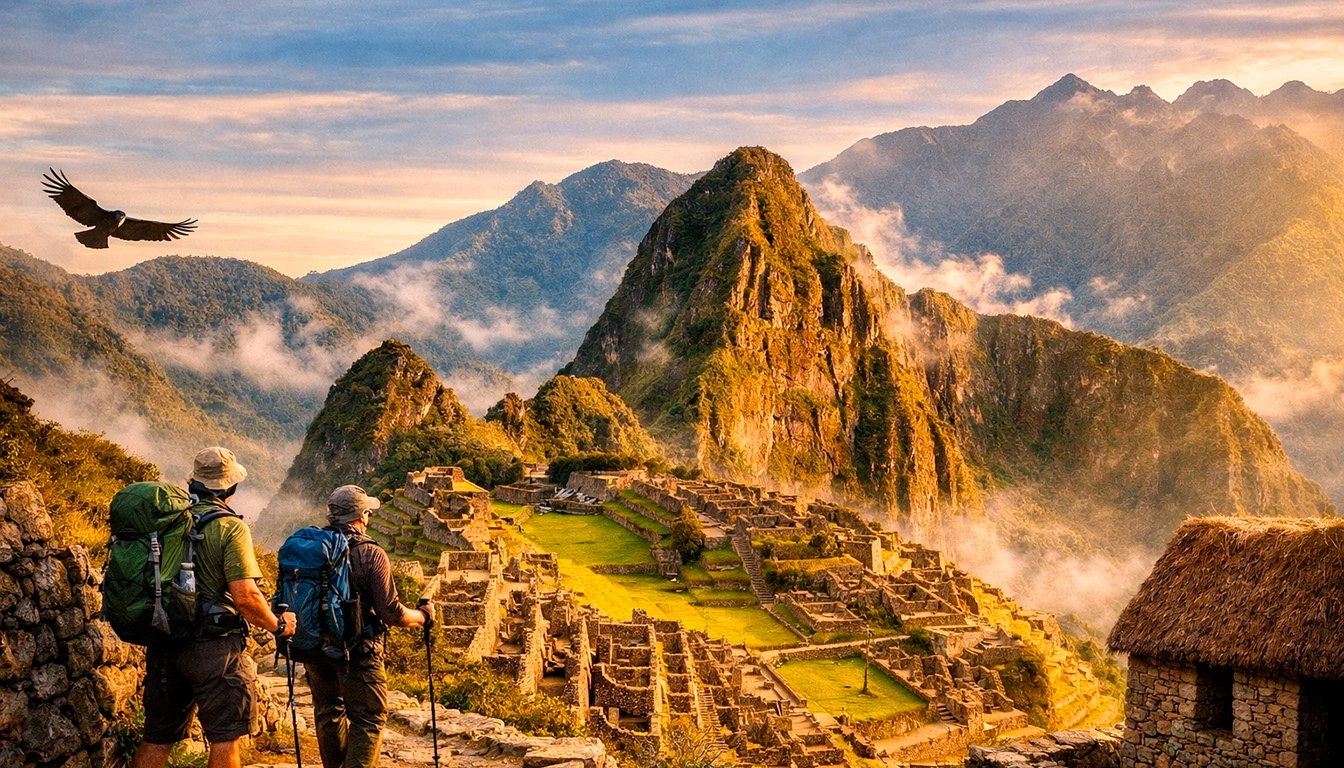
Machu Picchu appears slowly often framed by mist or soft morning light. First the outlines, then the terraces, and finally the full citadel.
It is not overwhelming. It is subtle.
And that is what makes it so powerful.
Because by then, you have experienced the mountains, the path, and the journey that leads to it.
It feels complete.
A More Meaningful Way to Travel Through Peru
For many travelers, the Inca Trail becomes a turning point in how they experience Peru.
Destinations like Cusco and the Sacred Valley begin to feel more connected. The landscapes make more sense. The history feels closer.
Travel becomes more than visiting places it becomes understanding them.
Beyond the Physical Challenge
While the trek requires preparation, what people remember most are not the physical efforts.
It’s the quiet moments.
The stillness of early mornings. The sound of the wind across the mountains. The feeling of being fully present.
These are the moments that stay with you.
Why the Inca Trail Still Matters
In a world where travel is often about speed and efficiency, the Inca Trail offers something rare.
It asks for time.
It asks for presence.
It invites you to slow down.
And in doing so, it creates an experience that stays with you long after the journey ends.
Because in the end, it was never just about reaching Machu Picchu.
It was about how you got there.